
Gazebo Buying Guide: Roof, Frame, Size and Extras
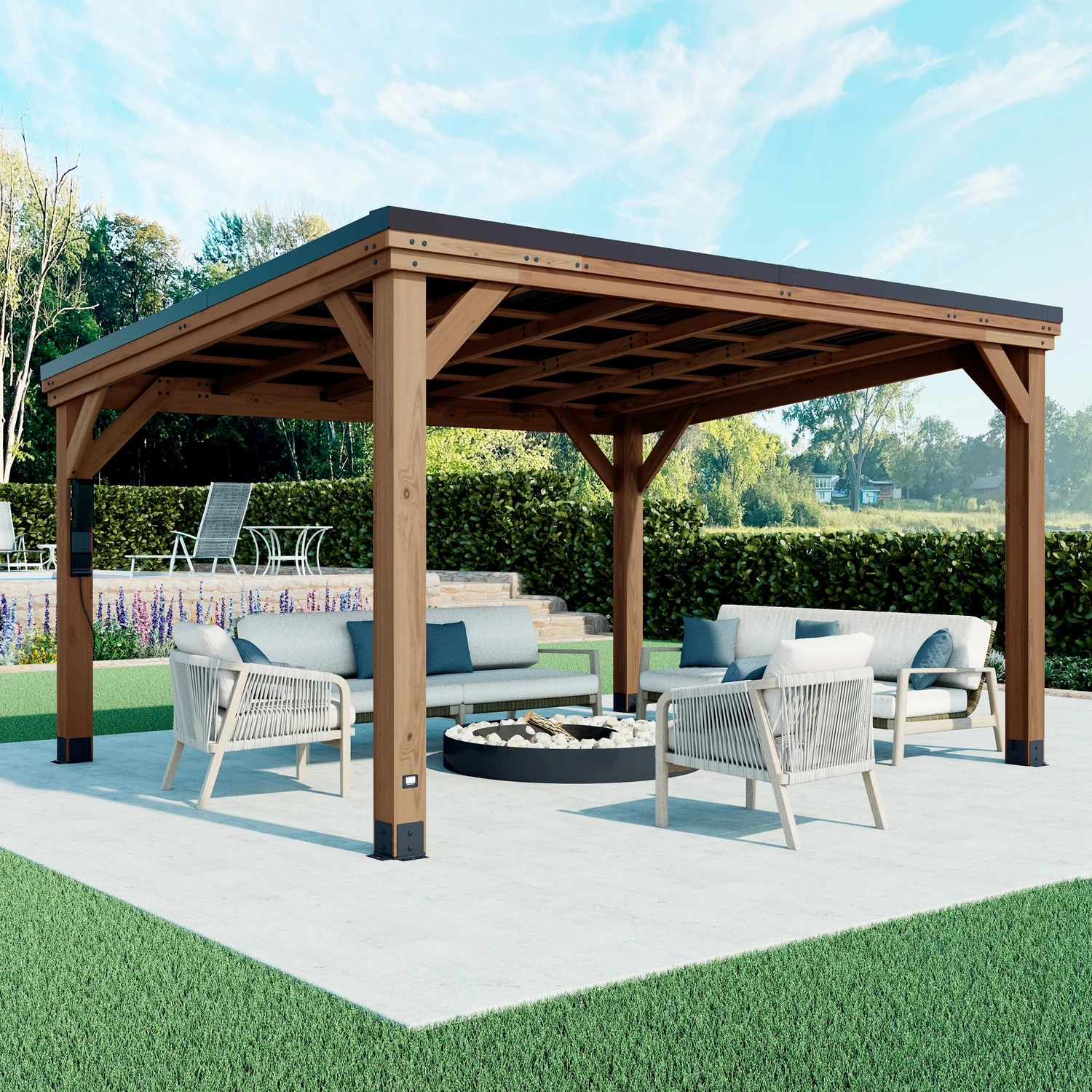
Pick the roof first in any gazebo buying guide: a soft top, a polycarbonate panel roof and a galvanized steel hardtop give three different kinds of shelter. Once you know whether you need light shade, filtered daylight or a solid cover for rain and snow, the frame, the size and the extras narrow the list quickly.
Which gazebo roof gives you the shelter you need?
Start overhead. A roof decides what a gazebo can do when the weather turns, and it splits our gazebo collection into three groups before frame or size even comes up. Fabric keeps the sun off a summer party. Clear panels let daylight in while cutting the glare. Steel gives you a fixed roof that is meant to stay up all year, so it is the one to look at if you want shelter you never take down.
Soft top: shade and screens for warm months
Fabric tops earn their place through what hangs from them. The Tomshoo 10 x 10 ft. two-tier soft top comes with zip-up mesh panels and an outer, solid layer of curtains, so you can sit in the open, behind mesh or fully closed in. Its canopy is water-resistant and drains rain through 8 grommet holes. Hot air escapes through a vent gap between the two tiers. Think of any fabric roof as fair-weather cover, and watch the forecast closely while it is up.
Polycarbonate: a hard roof that lets light in
Polycarbonate sits between fabric and metal. Under the Erommy 10 x 13 ft. polycarbonate double roof gazebo, daylight comes through the panels, so the shade feels softer than it would under steel. Two tiers with a raised vent between them give warm air a way out at the top. Erommy markets the panels on UV blocking but publishes no measured figure for it, so treat that claim as a description. Choose this roof for a covered sitting area that still feels bright, such as a spot just off the kitchen door.
Galvanized steel hardtop: the fixed roof
Steel is where wind and snow ratings matter most, because this is the roof you leave in place. Backyard Discovery puts a single-slope roof of 29-gauge galvanized steel on the Arcadia 14 x 12 ft. in place of the usual peak. Its maker rates this size for 100 mph of wind and 8,700 lb of snow, about 30 in, as long as the posts are properly anchored. Those numbers apply to this model alone. Another hardtop in the same search can carry a different rating or none at all, so read each product page instead of assuming steel means one standard.
Should the frame be cedar, steel or aluminum?
With the roof chosen, the frame comes down to looks and upkeep. Cedar is the traditional pick. The Arcadia 14 x 12 ft. frame is all cedar. Every board arrives already cut, drilled and stained light brown. Wood still wants some care, so check the finish each spring and reseal it once it starts to look dry.
Aluminum suits buyers who like the look of wood but not the chores. On Erommy’s 12 x 12 ft. wood grain aluminum hardtop, a timber pattern is printed onto the aluminum, so the posts never rot and never need sealing. Each post is a triangular section with a powder coat, 4.7 in across both faces.
Steel shows up in frames as well: Tomshoo lists its soft top frame as aluminum and steel, powder-coated to resist rust. Read the frame line on every listing closely. On the Erommy 10 x 13 ft., one part of the maker’s listing names aluminum and another names powder-coated steel, and our page does not pick between them. If frame material decides it for you, ask us before you order.
What size gazebo fits your patio?
Measure between the posts, not the roof. A size in a product name usually describes the roof, while your table and chairs have to fit inside the legs. Erommy’s drawing for the 12 x 12 ft. model sets the posts 11.3 ft apart each way, with the eave at 6.8 ft. Tomshoo’s legs stand 9.5 ft apart and the eave is 6.5 ft high, so tall guests should mind their heads at the edge. At the large end, the Arcadia 14 x 12 ft. covers about 168 sq ft, room for a ten-seat table with space to walk along one side.
Headroom at the edge is easy to overlook, so here are the four roofs side by side, using each maker’s own drawing.
| Gazebo | Roof | Frame | Lowest roof edge |
|---|---|---|---|
| Tomshoo 10 x 10 ft. | Two-tier soft top | Aluminum and steel | 6.5 ft eave |
| Erommy 10 x 13 ft. | Two-tier polycarbonate | Not confirmed by Erommy | 6.5 ft eave |
| Erommy 12 x 12 ft. | Galvanized steel, double roof | Wood grain aluminum | 6.8 ft eave |
| Arcadia 14 x 12 ft. | 29-gauge galvanized steel, single slope | Cedar | 6 ft 2 3/4 in, low side |
Size has a second check: what your lot allows. Before ordering, call the town’s building office about permits and setback distances for a backyard structure, and check with your homeowners association too if one covers your street.
Which extras should you check before you order?
Extras are where two similar gazebos stop being equal. One post on the Arcadia 14 x 12 ft. carries a PowerPort with 3 electrical outlets and 3 USB ports. Any outlet strip on a gazebo still needs a supply run to it, and our guide to power to a gazebo walks through feeding it safely. Netting is a separate question. On that same Arcadia, mosquito netting is an optional extra sold on its own.
On Erommy’s 12 x 12 ft. model, every side has two layers, zip-up mesh plus a privacy drape, hung on a double track so either one can close alone. Lights go on two J-shaped hooks under its roof, and a fan goes on a U-shaped one. Rain leaves through small holes in a gutter at the eaves instead of pouring off a corner. Before comparing models, write down the extras you will use, then check each listing for whether they come in the box or are sold separately.
What should you plan for delivery, assembly and returns?
Assembly falls to you or to someone you hire, as our store ships the kit and does not put it together. Backyard Discovery guides the Arcadia 14 x 12 ft. build through its BILT 3D app but gives no crew size or hours for it, so line up more than one helper before delivery day. Larger structures travel by freight, and the freight company usually phones first to set a delivery window; somebody has to be home to receive it, as our shipping policy explains.
Should the gazebo turn out too big for the yard, our refund and return policy allows 90 days from delivery for an unused item in its original packaging. Warranty terms come from each maker and vary by product, so read the warranty and replacement page and the product page together.
Frequently asked questions
What is the difference between a soft top and a hardtop gazebo?
A soft top uses a fabric canopy over a light frame and suits warm-weather shade and bug screens. A hardtop has a fixed roof of steel, aluminum composite or polycarbonate panels and is built to stay up longer. Wind and snow ratings, where a maker publishes them, are on each product page.
Is a polycarbonate gazebo roof brighter than steel?
Yes. Polycarbonate panels let daylight through, so the shade is softer and the space feels brighter than under a metal roof. Steel blocks the light completely. If you want a dim, cool spot for the afternoon, steel is the better match; for a bright outdoor sitting room, polycarbonate fits.
Does a cedar gazebo need sealing?
Cedar resists rot and insects on its own, but some makers advise a wood sealant, and it is often not included. Check the product page and manual for the model you choose, then inspect the finish each year and reseal when the wood starts to look dry or gray.
How do I measure my patio for a gazebo?
Measure the clear space between the posts, not the roof size in the name, and lay your table and chairs out at that size on the patio. Check the eave height too, since tall guests feel a low edge first. Leave room to walk around the outside.
Are curtains and netting included with a gazebo?
Some gazebos include both, while others sell netting as a separate extra. Read the product title and the in-the-box details before ordering, and confirm whether the sides hang on one track or two, since a double track lets the mesh and the curtains close separately.