
Can You Put a Grill or Fire Pit Under a Gazebo?
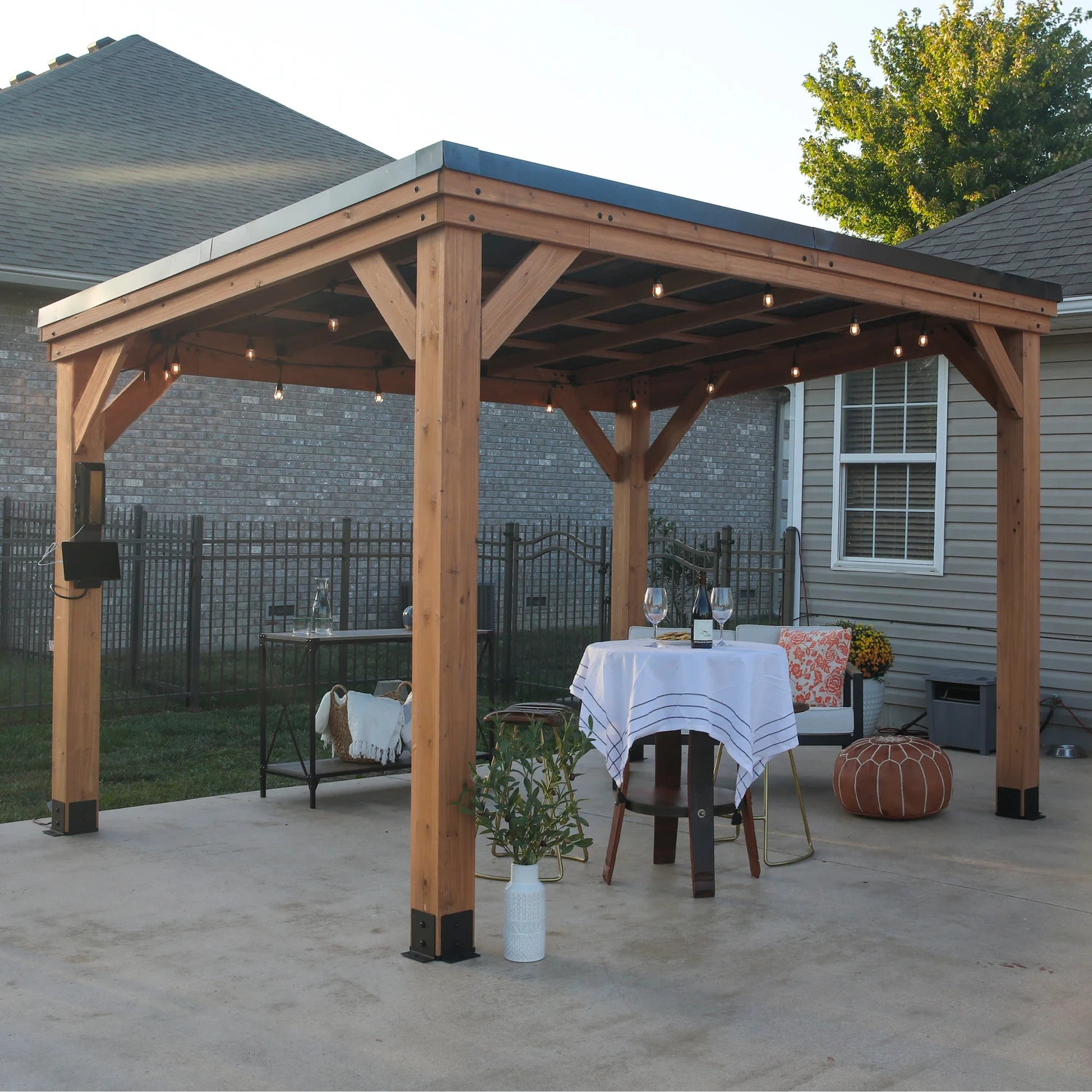
Not under an ordinary gazebo. The National Fire Protection Association (NFPA) tells grillers to keep the grill well clear of the house and the deck rails, and never to cook beneath eaves or low tree limbs. A gazebo roof is overhead cover of exactly that kind. Backyard Discovery, which makes several of the gazebos sold on this site, puts it more bluntly in its owner booklet: wood is not fire resistant, it will burn, and grills, fire pits and fireplaces are a fire hazard when they sit too close to the structure. The one real exception is a gazebo designed and sold as a grill gazebo, used the way its own manual describes.
Why a gazebo roof counts as overhead cover
A gazebo is a roof on posts. Smoke, heat and grease vapor from a grill go up, and under a gazebo the first thing they meet is the underside of that roof and the beams holding it. That is the same situation NFPA’s guidance is written to avoid when it mentions eaves and overhanging branches: something combustible directly above an open cooking fire.
The numbers behind that advice are worth knowing. NFPA’s 2013 report on cooking equipment fires, as summarized by Connecticut’s fire prevention commission, found gas grills involved in an average of 7,200 home fires a year between 2007 and 2011, with charcoal and other solid-fuel grills adding about 1,400 more. More than a quarter of home structure grill fires (27 percent) began on a courtyard, terrace or patio, and 29 percent began on an exterior balcony or open porch. In other words, most of these fires start in the outdoor living spaces where people put gazebos.
June and July are the peak months, according to the same NFPA release. That is also when a gazebo gets the most use.
What the gazebo makers themselves say
Manufacturer instructions are the place to settle this, because they describe the specific structure in your yard. Backyard Discovery’s general information booklet, linked from its product pages, lists these points among its safety notes:
- Wood is not fireproof and will burn.
- Grills, fire pits and fireplaces create a fire risk if they are placed too close to the structure.
- Hardware should be checked and tightened at the start of the season and during it, because wood expands and contracts.
A steel roof does not change the first point. The Backyard Discovery Arcadia 12 x 9.5 ft. gazebo has a galvanized steel roof, and the Arcadia 14 x 12 ft. gazebo has a sloped galvanized steel roof on 6 x 6 inch cedar posts. The roof panels are metal; the posts, beams and rafters under them are cedar. A flame or a flare-up reaches the wood frame long before it reaches the roof.
Grill gazebos are a different product
Some manufacturers build structures specifically for outdoor cooking, and the difference is in the design brief, not just the name. Backyard Discovery describes its Saxony XL Grill Gazebo as a cedar frame under a galvanized steel roof with room for two full-size grills, griddles or smokers, plus two powder-coated steel bar counters. Its Granada Grill Gazebo is described as accommodating grills up to 80 inches wide.
Those are cooking structures with a cooking layout. A general gazebo built for a dining set or lounge chairs has not been laid out around a heat source, and its manual does not give you the clearances that a grill gazebo’s manual does. If grilling under cover is the main reason you want a structure, shop for one that was designed for it and follow both manuals: the grill gazebo’s and the grill’s.
Fire pits: the same caution, with fewer exceptions
The Backyard Discovery booklet names fire pits alongside grills, and it does not split them into wood-burning and gas. Neither does the NFPA guidance cited above. So treat every open flame the same way. Before you place a fire pit anywhere near a gazebo:
- Find the clearance figure in the fire pit’s own manual, including any overhead clearance.
- Read the gazebo manual for its warnings about heat sources.
- If both cannot be met at once, the fire pit goes outside the gazebo’s footprint, not under it.
Open-roof structures need the same thought. The booklet’s warning is about distance from the structure, so a pergola’s rafters over a fire pit raise the same question as a gazebo roof, even with sky showing between the boards.
How to grill safely near a gazebo
Grilling beside a gazebo, rather than under it, is the common answer. NFPA’s general advice applies directly:
- Use propane and charcoal grills only outdoors, and set the grill out from under the gazebo roof and away from the posts.
- Hold children and pets back at least three feet from wherever the grill stands.
- Clear anything that can burn from around the grill.
- Check the propane hose for leaks the first time you use the grill each year. A light soap-and-water solution on the hose will bubble where gas escapes.
- Open a gas grill’s lid before you light it.
- If the flame goes out, turn off the grill and the gas, then wait at least 15 minutes before relighting.
- Clean grease and fat off the grates and out of the trays below them on a regular schedule.
- Do not leave a lit grill unattended.
Charcoal needs one more step. Let the coals cool completely, then put them in a metal container with a lid. That container should not be stored under the gazebo either.
Where the grill should go instead
Think of the gazebo as the dining room and the grill as the kitchen next door. Put the grill on a stable, non-combustible surface outside the roofline and away from overhanging branches, then use the gazebo for eating and sitting. Check the grill manufacturer’s clearance figure for walls and overhead structures and measure it from the outside edge of the gazebo roof, not from the posts, because the roof overhang is the closest combustible surface.
If you are still choosing a structure, our gazebo collection lists the roof type and frame material for each model, which are the two details that matter most for this question.
Frequently asked questions
Is a metal-roof gazebo safe to grill under?
Not by default. On cedar models like the Arcadia, the galvanized steel roof sits on wooden posts, beams and rafters, and Backyard Discovery’s booklet states that wood is not fire resistant and will burn. Only a gazebo designed as a grill gazebo, used as its manual describes, is built for that job.
How far should a grill be from a gazebo?
NFPA’s guidance says to keep grills well away from structures and out from under eaves and branches, without giving one distance for every grill. Use the clearance printed in your grill’s manual and measure it from the edge of the gazebo roof.
Can I put a gas fire pit under a gazebo?
Backyard Discovery’s safety notes list fire pits as a fire risk near its structures without excluding gas models. Follow the fire pit maker’s clearance figures, including overhead clearance, and if the gazebo cannot meet them, place the fire pit outside its footprint.
When do most home grill fires happen?
NFPA reports that home fires involving grills peak in June and July, the same months when outdoor structures like gazebos see the most use.
What is the most common cause of gas grill fires?
According to NFPA, leaks or breaks in the propane gas hose were the leading factor in gas grill fires. Checking the hose with soapy water at the start of each season is the simple test NFPA recommends.