
How Much Shade Does a Pergola Give? Sun Angle, Slats and Roof Type
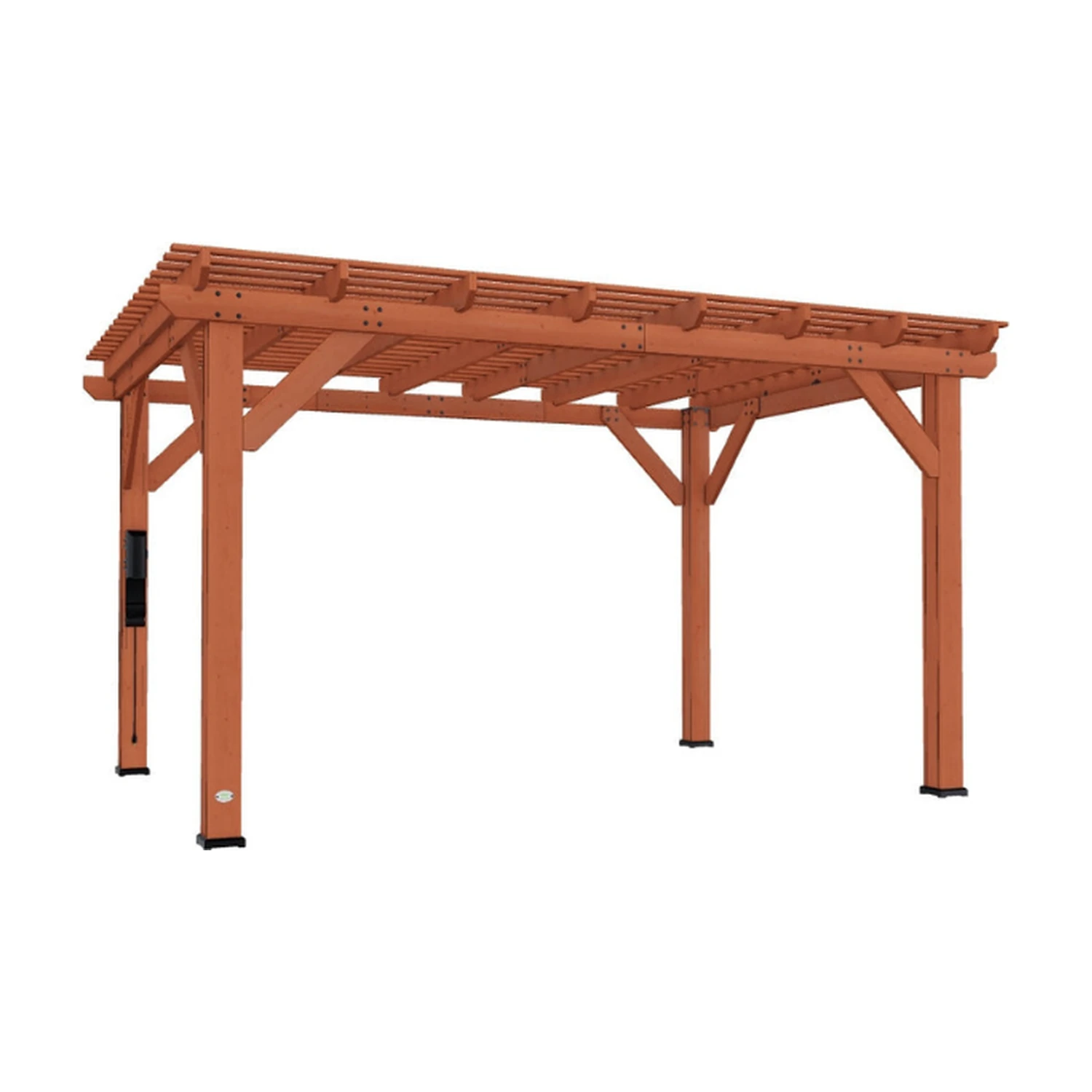
Pergola shade from a slatted roof is partial and it changes through the day and the year. How much you get depends on three things: how deep and how closely spaced the roof boards are, which direction they run, and how high the sun is. In midsummer the noon sun stands high over most of the US, so an open roof lets a lot of light through; when the sun is lower, the same boards overlap and the shade fills in. If you need full shade on demand, only a roof that closes, such as a louvered pergola with its blades shut, can give it.
How high the sun gets where you live
At solar noon the sun’s height above the horizon is 90 degrees minus the gap between your latitude and the sun’s declination. That relationship falls straight out of NOAA’s solar position equations. The declination swings from about +23.44 degrees at the June solstice to 0 at the equinoxes and about -23.44 degrees in December.
Here is what that gives at noon for a few US locations, at the June solstice, the March and September equinoxes, and the December solstice:
| Location | June | Mar / Sep | Dec |
|---|---|---|---|
| Camp Verde, AZ (34.5° N) | 78.9° | 55.5° | 32.1° |
| Phoenix, AZ (33.45° N) | 80.0° | 56.5° | 33.1° |
| Seattle, WA (47.6° N) | 65.8° | 42.4° | 19.0° |
| Miami, FL (25.8° N) | 87.6° | 64.2° | 40.8° |
The pattern matters more than the decimals. The farther south you are, the closer the summer sun gets to straight overhead, and a near-vertical sun slips between roof boards easily.
Slat depth and spacing: a worked example
Take an example roof (not any particular product) of boards 1.5 inches thick and 5.5 inches deep, set on edge at 12 inches center to center. When the sun shines across the boards, each one shades its own 1.5-inch thickness plus a strip equal to its depth divided by the tangent of the sun’s height.
| Sun height | Extra shadow per board | Roof shaded |
|---|---|---|
| 78.9° (Camp Verde, June noon) | about 1.1 in | about 21% |
| 55.5° (Camp Verde, equinox noon) | about 3.8 in | about 44% |
| 32.1° (Camp Verde, December noon) | about 8.8 in | about 86% |
Two lessons follow. First, deeper boards or tighter spacing raise the shaded share at every sun height, which is why roof design matters more than footprint for shade. Second, a slatted pergola gives the least shade exactly when the summer sun is highest. Plan for that if your main goal is midday cover in July.
Which way the boards should run
The worked example assumes the sun shines across the boards. When the sun shines along them, the boards barely overlap and the shade drops to roughly their thickness divided by their spacing, 1.5 in 12, or about 12.5 percent.
In the continental US the noon sun is always to the south. So top boards running east to west catch the midday sun across their faces and give the most noon shade. Boards running north to south do their best work in the morning and late afternoon, when the sun is low in the east or west. If your pergola has two layers, rafters one way and purlins the other, you get some of both.
The shade moves, and roof height decides how far
A roof does not shade the ground directly beneath it unless the sun is overhead. The shadow shifts away from the sun by the roof height divided by the tangent of the sun’s height. For a roof about 96 inches high, that is roughly:
- about 19 inches at 78.9 degrees (June noon at 34.5° N)
- about 66 inches at 55.5 degrees (equinox noon)
- about 153 inches, close to 13 feet, at 32.1 degrees (December noon)
For a sense of scale, the DuraTrel Kingston 7 x 7 ft. vinyl pergola is listed by DuraTrel at 105 inches square outside and 96 inches high, with 84 inches square and 80 inches high inside. In June its noon shadow falls almost entirely within the footprint. By December the shadow has moved more than a full pergola-width north, which is pleasant in winter when you want the sun.
Roof types compared
Manufacturers handle shade differently, and their own descriptions are the honest guide:
- Wide purlins. Backyard Discovery says the Delray 14 x 10 ft. pergola uses a wide purlin roof design that provides 20 percent more shade protection. Wider top boards are the “deeper board” lever from the example above.
- Multi-level trellis. The Beaumont pergola has a multi-level trellis roof that the maker says lets sunlight filter through for a mix of light and shade. Expect dappled light rather than cover.
- Louvers. The Evanston 12 x 10 ft. louvered pergola has an adjustable louvered roof that opens with a wand to let the sun in, or shuts to give complete shade and cover from the weather, with rainwater routed through downspouts in the posts. This is the only type here that gives full shade on demand.
Our pergola collection lists the roof type of each model, so you can compare like with like.
Frequently asked questions
Does a pergola provide full shade?
A slatted pergola gives partial shade that changes with the sun’s height and direction. A louvered pergola can give complete shade when its blades are closed, as Backyard Discovery describes for the Evanston.
Which direction should pergola slats run for the most shade?
In the continental US the noon sun is to the south, so top boards running east to west catch it across their faces and give the most midday shade. North-south boards shade best in the morning and late afternoon.
Why does my pergola give less shade in summer than in fall?
The summer sun is higher. With a sun nearly overhead, light passes between the boards with little overlap. As the sun gets lower in autumn, each board’s shadow widens and the gaps fill in.
Does a taller pergola give more shade?
Height does not change how much area the roof shades, but it changes where the shadow lands. The higher the roof and the lower the sun, the farther the shadow moves away from the footprint.
How do I work out the sun’s height at noon where I live?
Subtract the gap between your latitude and the sun’s declination from 90 degrees. The declination is about +23.44 degrees in late June, 0 at the equinoxes and about -23.44 degrees in late December. NOAA publishes the full solar position equations.